Human cognition isn’t a single thread. You have a fast system. Pattern matching, intuition, the thing that lets you move through a conversation fluidly. And a slow system. The one that fact-checks, notices inconsistencies, connects dots across time. Both are necessary. Neither replaces the other.
Most AI assistants are built as a single synchronous process: prompt arrives, model responds, output lands. Fast, but missing the second system entirely.
I wanted my AI to work more like a human mind.
So I built a subconscious pass. After each conversation settles, a separate process fires about 60 seconds later. No session context, no continuity from the chat window. It reads the last 50 turns of the conversation plus the memory gateway results for whatever topic we’re discussing. Then it decides to stay silent or flag something.
Staying silent is the default. Most rounds it logs the run and exits. Silence is intentional. A second voice that talks too much becomes noise. So the prompt sets a high bar and a hard rate limit backs it up. At least 10 minutes and 5 turns must pass before it can speak again. Not a skeptical sibling. A second set of eyes with a strong bias toward quiet.
When it does speak, it surfaces in the Jarvis bubble with a 💭 chip so you know it’s the background pass. It queues to prepend to the next conscious response, so the two lanes merge coherently. One mind, two rates of thought.
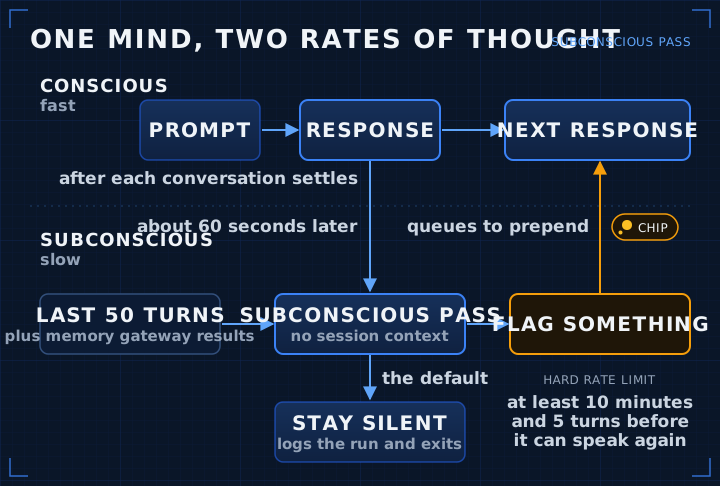
The effect is subtle in practice. Most conversations need only the conscious lane. But when something doesn’t land right, when a past decision gets revisited, when a fact from memory contradicts what just got said, when a pattern emerges across turns, the subconscious notices and surfaces it before it matters.
This is closer to how thinking should work. The conscious mind stays responsive and fluid. The subconscious runs the background check. Neither is waiting for the other. They’re just running in parallel, at different speeds, and they merge when it counts.
I tested it with planted inconsistencies. A media library size that didn’t match memory, a DVR diagnosis that contradicted a prior test. The subconscious caught both without needing to know they were seeded. It just noticed the gap and raised it.
Memory that only answers questions is half a system. The architecture that matters is the one that reads the conversation and asks whether the answers match what’s stored. This is that second half.