I thought I had designed a game economy because I’d designed a currency.
Parts come in every time you finish an order in Salvage Swarm. More parts for harder orders, and a clean-solve bonus if you cleared it without a spare bay or power-ups. The Supply Shop takes parts in exchange for power-ups. I drew a line from source to destination and called it an economy.
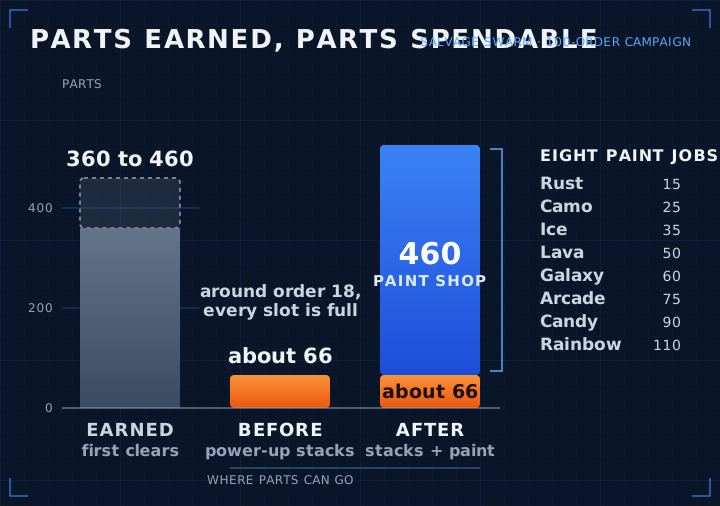
A reviewer caught what I hadn’t. First clears earn somewhere between 360 and 460 parts across the 100-order campaign. Filling your power-up stacks costs about 66 parts total. Around order 18, every slot is full and parts keep arriving with nowhere to go. The source was fine. I just hadn’t built enough room on the other end to absorb what the campaign paid out.
I added a paint shop. Eight paint jobs for your robot crew: Rust at 15 parts, Camo at 25, Ice at 35, Lava at 50, Galaxy at 60, Arcade at 75, Candy at 90, Rainbow at 110. The total lands at 460 parts, which is roughly what the full campaign pays. That wasn’t a coincidence.
But there was a decision inside that I didn’t see coming. The paints needed to show up during play, not just on a robot in a shop screen. Each paint leaves a trail when a robot flies. Neon leaves pink and cyan behind it. Gold throws sparks. You buy Arcade and you see Arcade on every robot trip for the rest of the game.
Cosmetics that live only in a selection menu feel like a ledger entry. You make the transaction once and the game continues unchanged. A trail runs on every move, through the middle of every order. The purchase stays visible in the thing you were already watching.
The “parts sink” label makes it sound cleaner than it was. Figuring out what earns its price at 15 parts versus 110 is a judgment call. So is asking what the player gets to watch after the transaction closes. The trails are the answer I landed on to that second question.
If I could go back to the moment I opened the supply shop and thought the economy was done, I’d tell myself to answer one question first: where does this purchase show up while the game is running?